
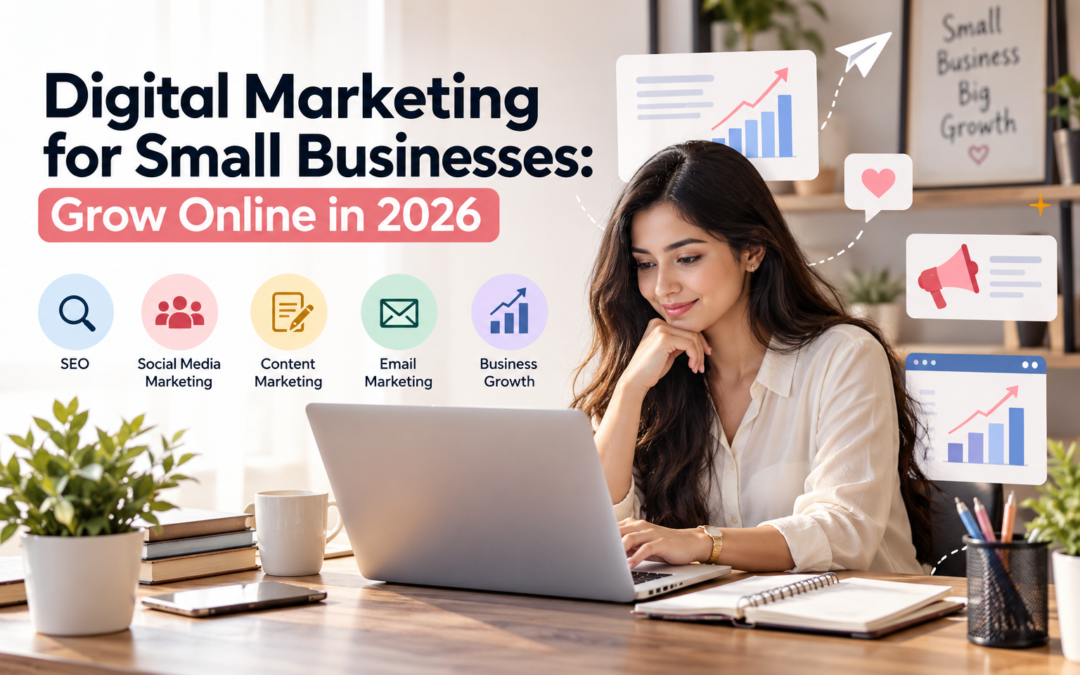
Digital marketing for small businesses is essential in 2026 because it helps brands reach potential customers, build trust, and grow their online presence. Customers often search online, compare brands, read reviews, and explore social media before making a purchase. If your business is difficult to find online, you could miss valuable opportunities to connect with potential customers.
Digital marketing for small businesses includes strategies such as SEO, social media marketing, content creation, and email marketing to help brands reach potential customers and build their online presence.
This is where digital marketing becomes important.
Digital marketing helps small businesses build brand awareness, reach their target audience, generate enquiries, and develop long-term customer relationships. The best part is that businesses can start with a limited budget by choosing the right strategies and using suitable digital tools.
In this guide, we will explore how small businesses can grow online with digital marketing in 2026.
Digital Marketing for Small Businesses: Where to Start
1. Build a Professional Website
Your website can act as your business’s online home. It allows potential customers to learn about your products, services, location, pricing, and contact details.
A strong website is an important foundation for digital marketing for small businesses because it helps potential customers discover services and take action.
A professional website helps establish credibility and gives customers a convenient way to contact you.
Here are some essential elements of a good business website:
- A clear homepage explaining what your business offers.
- Dedicated product or service pages.
- Contact details, including email and WhatsApp where appropriate.
- Genuine customer testimonials and reviews.
- Clear calls to action, such as “Get a Quote,” “Shop Now,” or “Contact Us.”
- A mobile-friendly design and fast loading speed.
For example, a jewellery store can showcase its collections online, while a digital marketing freelancer can display services, sample projects, and testimonials.
You do not always need an expensive website to get started. Choose a solution that fits your budget and improve it as your business grows.
2. Social Media Marketing for Small Businesses
Social media platforms allow businesses to connect with their target audience, showcase their offerings, and communicate directly with potential customers.
Platforms such as Instagram, Facebook, LinkedIn, and YouTube can support different marketing goals depending on your industry and audience.
Effective social media strategies include:
- Sharing useful tips related to your industry.
- Publishing high-quality photos, graphics, carousels, and short videos.
- Explaining how your products or services solve customer problems.
- Answering common customer questions.
- Sharing genuine customer feedback with permission.
- Including a clear call to action in relevant posts.
For example, a boutique can showcase new arrivals and styling ideas, while a salon can share haircare advice and information about its services.
Consistency matters more than posting randomly every day. Create a content calendar that you can realistically maintain and focus on content that helps your audience.
3. SEO Strategies for Small Businesses
Search engine optimisation, or SEO, helps your website appear in relevant search results. It can help potential customers discover your business when they search for products, services, or solutions.
Unlike paid advertising, SEO does not require you to pay for every click. However, it takes time, effort, and sometimes professional investment to achieve results.
Start with these SEO practices:
- Research keywords your potential customers are likely to search for.
- Use relevant keywords naturally in page titles, headings, and content.
- Write useful, original content that answers customer questions.
- Improve website loading speed and mobile usability.
- Add descriptive alternative text to meaningful images.
- Link related pages and blog posts together.
- Keep business information accurate and consistent online.
For local businesses, local SEO is particularly valuable. A business serving customers in Chennai, for example, can create helpful pages describing its services and the areas it genuinely serves.
Avoid repeating keywords unnaturally or creating multiple low-quality pages just to rank on Google. Focus on useful information that genuinely helps visitors.
For more guidance, read Google’s official SEO Starter Guide to learn the fundamentals of improving your website’s visibility in search results.
4. Optimise Your Google Business Profile
If your business serves customers at a physical location or travels to serve them in a defined area, a Google Business Profile can help people discover your business through Google Search and Maps.
A well-maintained profile provides useful information and makes it easier for potential customers to contact you.
To improve your profile:
- Choose the most accurate business category.
- Add correct business hours and contact information.
- Upload genuine photos of your products, premises, or work.
- Describe your services clearly.
- Encourage satisfied customers to leave honest reviews.
- Respond professionally to reviews and customer questions.
- Keep information updated when anything changes.
A complete profile can support local discovery, but it does not guarantee a particular ranking or number of enquiries.
Businesses that operate entirely online without qualifying in-person customer contact should check Google’s eligibility requirements before creating a profile.
5. Content Marketing for Small Business Growth
Content marketing involves creating and sharing useful information to attract and educate your target audience.
Digital marketing for small businesses works best when useful content answers customers’ questions and supports their buying decisions.
Instead of constantly promoting products, help people understand their problems and make informed decisions. Useful content can build familiarity with your brand and give customers reasons to return.
Examples of content include:
- Blog posts answering common customer questions.
- Educational Instagram carousels.
- Product demonstrations and tutorials.
- Frequently asked questions.
- Case studies showing real work and results.
- Short videos explaining your services.
For example, a skincare business could publish a guide explaining how to build a basic skincare routine. A digital marketing professional could write about common Instagram profile mistakes made by small businesses.
A practical content tip is to start with one useful topic and adapt it into several formats. A blog post can become a carousel, a short video script, an email newsletter, and a series of social media tips.
This helps you maintain a consistent online presence without creating every piece of content from scratch.
6. Use AI Tools to Work More Efficiently
Artificial intelligence tools can help small businesses plan, draft, organise, and improve their marketing activities. They are especially useful when a business has limited time or a small team.
AI can assist with:
- Brainstorming blog topics and content ideas.
- Drafting social media captions.
- Creating first drafts of email campaigns.
- Developing content calendars.
- Generating creative concepts for advertisements.
- Summarising performance data and identifying areas to investigate.
Tools such as ChatGPT and Canva can support different parts of the content creation process.
However, AI-generated content should not be published without review. Check factual accuracy, remove generic claims, protect confidential customer information, and ensure the content reflects your brand’s voice.
AI is most useful when it supports human judgement and creativity rather than replacing them entirely.
7. Build an Email and Customer Follow-Up Strategy
Social media helps people discover your business, but you also need a way to maintain relationships with interested customers.
Email marketing can help you share updates, useful information, offers, and product announcements with people who have chosen to hear from you.
You can use email to:
- Welcome new subscribers.
- Share helpful guides and resources.
- Announce new products or services.
- Send relevant offers.
- Follow up on enquiries.
- Encourage repeat purchases when appropriate.
For example, a gift business might send subscribers updates about new collections and seasonal gift ideas.
Always obtain appropriate permission, follow applicable privacy and marketing rules, and provide a clear way for recipients to unsubscribe.
For businesses that receive enquiries through WhatsApp or direct messages, a simple and timely follow-up process can also help prevent genuine customer enquiries from being overlooked.
8. Paid Advertising Strategies for Small Businesses
Paid advertising can help businesses reach specific audiences and test offers more quickly than relying on organic content alone.
Depending on the business, options include Meta Ads on Facebook and Instagram, Google Search Ads, and other relevant advertising platforms.
Before spending money, make sure you have:
- A clearly defined target audience.
- A specific campaign objective.
- A compelling offer or message.
- A relevant landing page or contact destination.
- A way to track leads, enquiries, purchases, or other meaningful outcomes.
- A budget you can afford to test.
Start with a controlled experiment rather than spending heavily without a plan. Review the results and use the evidence to decide what to improve.
Remember that advertising does not guarantee sales. Your offer, audience, website experience, pricing, and follow-up process all affect the outcome.
9. Measure Digital Marketing Results
Digital marketing is not just about publishing content or running campaigns. It is also about understanding what works and improving your approach over time.
Use analytics tools to monitor the results that matter to your business.
| Marketing Channel | Useful Metrics |
|---|---|
| Website | Visitors, engagement, enquiries, conversions |
| SEO | Search impressions, clicks, relevant search queries |
| Social media | Reach, saves, shares, profile visits, enquiries |
| Clicks, conversions, unsubscribes | |
| Paid advertising | Spend, cost per lead, conversions, return on ad spend |
Choose metrics that reflect your actual business goals. For instance, a local service provider may care more about qualified enquiries than the total number of followers.
Review your performance regularly, identify patterns, and test one improvement at a time. This makes it easier to learn which activities deserve more attention and budget.
10. Create a Simple Digital Marketing Plan on a Small Budget
Small businesses do not need to use every platform or strategy at once. A focused plan is often easier to manage and evaluate.
Here is a simple four-week starting plan.
Week 1: Build Your Foundation
Review your website, social media profiles, contact details, and core message. Make sure customers understand what you offer and how to contact you.
Week 2: Publish Useful Content
Create a small batch of educational posts, answer common questions, and publish one helpful blog article relevant to your audience.
Week 3: Improve Discoverability
Work on relevant SEO improvements, review local search opportunities if eligible, and make it easy for visitors to enquire.
Week 4: Measure and Refine
Review engagement, website visits, enquiries, and conversions. Identify the most promising activities and plan the next month accordingly.
This is a starting framework, not a promise of results within four weeks. SEO and audience growth often require sustained effort over a longer period.
When Should a Small Business Hire a Digital Marketer?
Managing digital marketing independently can work in the early stages, but it can become difficult when business owners have limited time, lack specialist knowledge, or need a more consistent strategy.
A digital marketing professional can help with content planning, social media management, SEO, website improvements, and performance reporting.
Before hiring someone, identify the business problem you want to solve. Then choose a professional whose services match your needs, agree on deliverables, and define how progress will be measured.
The right support should make your marketing more organised and purposeful, rather than simply increasing the number of posts you publish.
Conclusion
Growing a small business online in 2026 does not require you to do everything at once. Start with a clear website, useful social media content, relevant SEO, consistent customer communication, and a simple way to measure results.
Use AI tools where they save time, experiment carefully with paid advertising, and focus on the activities that help your business reach the right audience and generate meaningful enquiries.
Most importantly, treat digital marketing as an ongoing process. Learn from your results, improve your approach, and build trust with your customers over time.
Want to strengthen your business’s online presence?
At VisionByHarshita, the focus is on practical digital marketing, content strategy, and improving how businesses present themselves online.
If you would like to identify opportunities to improve your Instagram profile or website, get in touch with VisionByHarshita to discuss a free initial review.